The Biggest Misunderstanding in Insulation
When homeowners research insulation, the first thing they usually focus on is the R-rating.
- R5.
- R6.
- R7.
The assumption is simple: the higher the number, the better the performance.
In reality, this is one of the most common misconceptions in the insulation industry.
While insulation ratings are important, they do not represent what most homes actually achieve once insulation is installed inside a roof space.
What an Insulation R-Rating Really Means
An insulation R-rating measures a product’s resistance to heat flow under controlled laboratory conditions.
These tests assume:
- Perfect installation
- Continuous, uninterrupted coverage
- No timber framing interrupting insulation
- No gaps or compression
- No air movement
In other words, the R-rating reflects the performance of the insulation material itself, not the performance of the insulation system once installed in a real home.
Why Roof Spaces Behave Very Differently to Laboratories
Roof cavities are one of the harshest environments in a house.
Once insulation is installed, it must perform around:
- Timber ceiling joists and structural framing
- Electrical wiring, ducting, and services
- Irregular spacing and roof geometry
- Tight perimeter edges and penetrations
- Air movement within the roof cavity
- Extreme summer heat and winter cold
Each of these factors reduces the effective thermal performance of insulation, regardless of how high the rating on the product packaging may be.
Insulation Rating vs Insulation System Performance
This is the most important distinction homeowners are rarely told:
An insulation rating is not the same as insulation performance.
The rating applies to the product.
Performance depends on the entire ceiling system.
If insulation is:
- Interrupted by exposed ceiling joists
- Installed with gaps or inconsistent coverage
- Compressed or poorly detailed
- Missing at perimeter edges
Then the system will never perform at its rated value, even when high-rated insulation is used.
Thermal Bridging: One of the Biggest Causes of Performance Loss
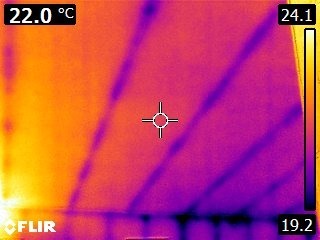
One of the primary reasons insulation underperforms is thermal bridging.
Thermal bridging occurs when heat bypasses insulation through materials that conduct heat more easily — most commonly timber ceiling joists.
Ceiling joists:
- Run continuously across the ceiling
- Have far lower thermal resistance than insulation
- Act as direct heat-transfer pathways
When joists are left uninsulated, heat moves through them freely, bypassing the insulation entirely.
Building-science modelling shows that exposed ceiling joists can reduce real-world ceiling insulation performance by approximately 20–40%, depending on framing density, detailing, and installation quality.
This means a ceiling fitted with R6 or R7 insulation may behave closer to R3.5–R4.5 in real conditions.
Why Most Homes Never Achieve Their Advertised R-Value
In practice, many homes achieve only 60–80% of the insulation rating homeowners expect, and sometimes less.
Common reasons include:
- Focus on product thickness instead of coverage continuity
- Gaps at ceiling edges and penetrations
- Ignoring thermal bridging through framing
- Inconsistent or rushed installation methods
- Poor detailing in tight or complex roof areas
This explains why two homes with the same insulation rating can feel completely different in comfort and energy efficiency.
Why System Design Matters More Than Rating Alone
A poorly installed high-rated system can perform worse than a well-designed lower-rated system.
True insulation performance comes from:
- Continuous coverage
- Minimising thermal bridges
- Correct edge and perimeter detailing
- Maintaining insulation loft and thickness
- Installation methods suited to the roof structure
- This is where insulation systems, not just products, make the difference.
- Our R7 Thermal Blanket System: Designed for Real-World Performance
- Standard insulation installs typically place bulk insulation between ceiling joists only.
While this may achieve a nominal R-rating on paper, it leaves the ceiling system vulnerable to thermal bridging and performance loss.
Our R7 Thermal Blanket System is designed to overcome these limitations by treating insulation as a complete thermal system, not just individual batts.
Rather than insulating around the structure, the system focuses on insulating across and through the ceiling plane to improve continuity and reduce heat-transfer pathways.
How the R7 Thermal Blanket System Improves Efficiency
By addressing common weak points found in standard installs, the R7 Thermal Blanket System:
- Reduces heat flow through ceiling joists
- Minimises thermal bridging across the ceiling structure
- Improves temperature consistency throughout the home
- Allows the insulation system to perform closer to its intended R-value
In real-world conditions, this means the system retains more of its rated performance, rather than losing a large portion of it through framing and gaps.
Why This Matters in Practical Terms
In conventional installs, exposed ceiling joists can undermine insulation performance by up to 20–40%.
By reducing these losses, a thermal-blanket-style approach:
- Improves winter heat retention
- Reduces summer heat ingress
- Delivers more stable indoor temperatures
- Provides better long-term energy efficiency
- This approach focuses on achievable performance, not just theoretical ratings.
The Takeaway: Ratings Are a Starting Point, Not a Guarantee
Insulation ratings are useful — but they are not guarantees of real-world performance.
They represent laboratory potential, not how insulation behaves inside a roof cavity with framing, gaps, and environmental conditions.
Homes that perform well thermally do so because the insulation has been installed as a complete system, designed to minimise losses and maximise retained performance.
Important Note on Insulation Ratings & Performance
Insulation R-ratings are laboratory-tested values measured under controlled conditions.
In real roof environments, factors such as thermal bridging, gaps, air movement, roof geometry, and installation quality can reduce the effective thermal performance of an insulation system.
Actual performance varies by construction type and detailing and may be lower than the nominal R-value printed on product packaging.